-->

Tuesday, 8 December 2015

Ambient Occlusion - Gyro


I woke up groggy, knocked back a few coffees and contemplated watching Only God Forgives and
La belle et la bĂȘte to get the final two reviews done. 

I ended up watching Lost River (Ryan Gosling's second directing attempt) and focusing on finishing this shot. I feel great surge of enthusiasm at this sight. Before, I hadn't had that moment where the penny drops and held a full appreciation for the skills I've gained over the last couple of months. But strangely, within this image, my penny finally dropped. 

(I'm going to muck around with the placement of the docks in the midground, as well as entertaining the possibility of including more cars on the road, which I might add, was more challenging to model than I had anticipated). 

I'll finish the lighting today, before nipping off to watch an old Dana Andrews film. 


Monday, 7 December 2015

Modelling/UV progress.


So, Here's where I am right now. (More or less, the more being I'm currently making speedy progress in setting my scene up).

I've found the UV'ing a challenge at times, but I also do feel like some form of understanding is forming around the practice.

I'm focusing on the lighting next, then I'll move on to texturing.

Ciao!

Saturday, 5 December 2015

Gyro - Final Composition with breakdown.


It is finally posted, after a week of living within my memory stick waiting for me to stop wrestling with rogue Uv's. I am both pleased and a little dumbfounded that I've created this. And I'm looking forward to the final composite.

Back to those now :)

"Suspiria" (1977) - A review.

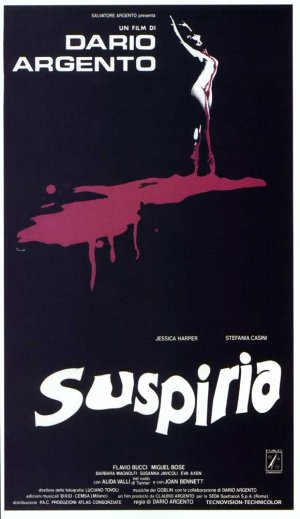
Fig 1.
“Suspiria” (1977) by director Dario Argento focuses on Suzy Bannion, an American ballet student, after transferring to a prestigious dance school in Germany. Things are - in typical fashion - not as they seem as fellow students go ‘missing’ in ways most macabre. Bannion discovers the dark history of the dance school, and its secondary purpose, to provide fresh bodies to a witches coven, for some undisclosed ritualistic reasoning. Another study in atmosphere, “Suspiria” is certainly a gaudy affair that manages to achieve a tension so realised as to cement itself in the collective psyche. But it is not only these things, “Argento chooses the narrative trope of the fairy tale to narrate the negative effects of black magic on people and the horrific consequences that may derive from opposing the occult power of witches.” (Giusti, 2013).  And this juxtaposition between fairytale and horror creates a dissonance.  It’s a dissonance that we become accustomed to at the very beginning of the film; During the titles we are calmly fed bits of exposition, initially backed by a score reminiscent of music boxes of old before serenity is broken swiftly by a score change and a violent mix of diegetic and nondiegetic noises, so successful that immediately the tone of the film is set. Suzy’s world is violent, confusing and definitely not geared towards a stranger in a strange place.
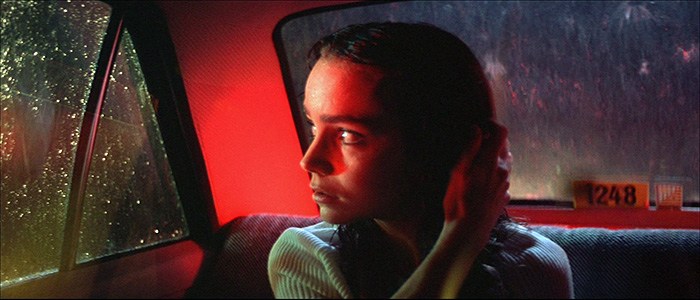

Fig 2.


Often “Suspiria” shines because of the tableaux of sound woven around it. And by no means should this sentence sound romantic, as the soundscape is violent and often times challenging; mirrored in the story itself. This sonic assault is achieved through repetition, Linda Schulte-Sasse writing for Kinoeye, mentions that the sound is... “overlaid with a repetitive, frantic and compelling musical soundtrack by the rock group Goblin, whose sound has become a hallmark of some key Argento films.” (Schulte-Sasse, 2002) and this really goes a long way of selling the inherent trauma of the dance school. Indeed the term - Suspiria - means sigh, but there is irony in that descriptor, as Suspiria is anything but a mere sigh; it is an explosion of sound and image, a furious and violent last gasp.
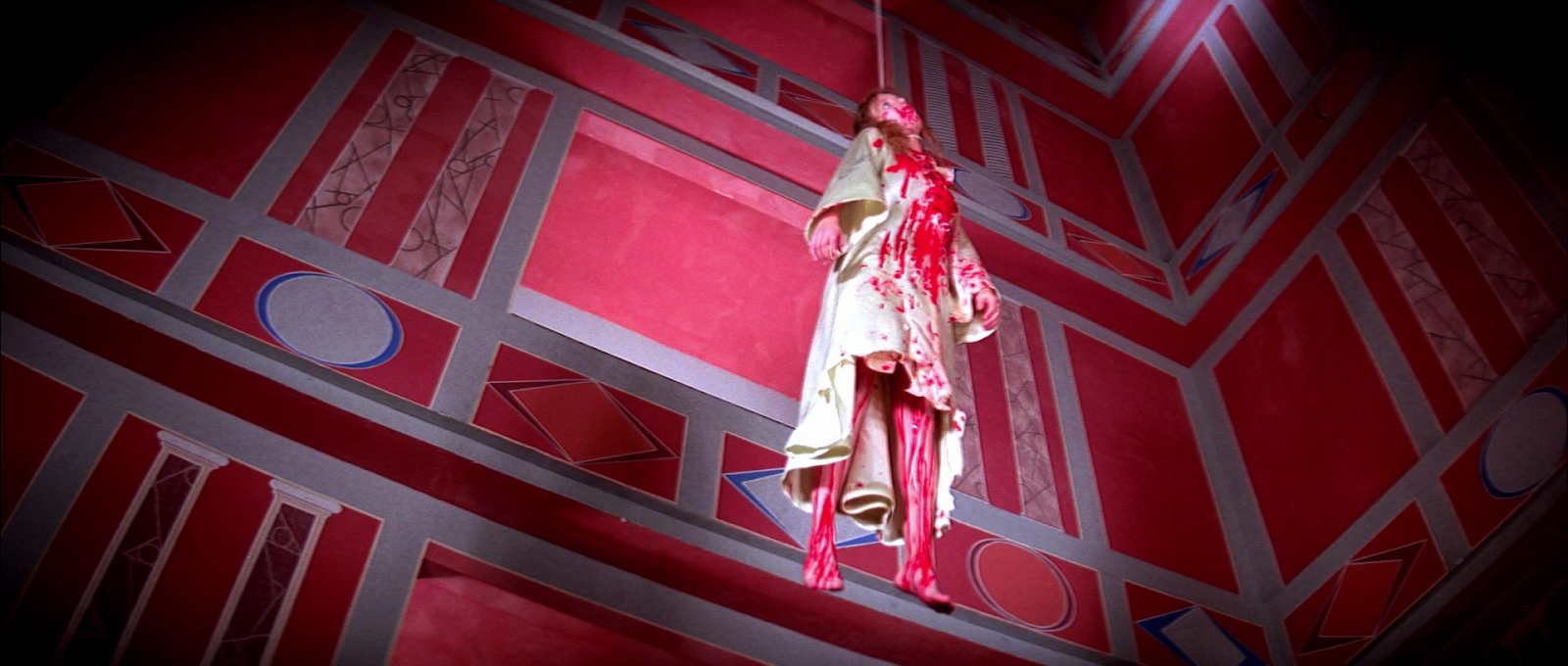

Fig 3.


A technicolour nightmare, “Suspiria”  is dripping in vivid reds, suffocating blues and intoxicating greens, each part working in tandem to create the film’s many moods. Of course, we can deduce the red hues as being that of the negative or the supernatural, but interestingly most of the film is staged in this light, and we are instead taught to fear the unknown shades of blue and the onset of green. The film is so consistently lit that we have no doubt as to the atmospheric qualities of “Suspiria”, and we are indeed subjected to these rules throughout the entire experience. The lighting is only part majesty of the film, indeed it is as if there is some deliberacy in the distancing between reality and the bubble universe that Suspiria sits within. “Argento has no interest in realism whatsoever;Suspiria is self-consciously stylised, artificial” (Schulte-Sasse, 2002) and this is interesting when paired with the comparisons “Suspiria” draws to cartoons in both plot, style and general mise en scene. Argento himself has stated the parallels he hoped to draw between his work and that of Walt Disney’s “Snow White” (1937).


“Suspiria” is a jarring experience of the occult spat through the rose tinted lense of the fairy tale. It is ballsy, arresting and at times mesmeric in its design.

Bibliography


Giusti, Giulio. 'Expressionist Use of Colour Palette and Set Design in Dario Argento’s Suspiria (1977)| Giulio L. Giusti'. cinergie.it. [online] Available at: http://www.cinergie.it/?p=3288 [Accessed 05 Dec. 2015]


Schulte-Sasse, Linda. 'The "mother" of all horror movies''. [online] Available at: http://www.kinoeye.org/02/11/schultesasse11.php [Accessed 05 Dec. 2015]


Illustrations


Fig 1. Suspiria poster. [image] Available at: https://upload.wikimedia.org/wikipedia/en/c/cd/SuspiriaItaly.jpg [Accessed 05 Dec. 2015]


Fig 2. Taxi to dance school - still. [image] Available at: http://bingemedia.net/wp-content/uploads/2013/10/Cap-3.jpg [Accessed 05 Dec. 2015]


Fig 3. The first murder - still. [image] Available at: http://screenmusings.org/movie/blu-ray/Suspiria/images/Suspiria-051.jpg [Accessed 05 Dec. 2015]


Monday, 30 November 2015

Gyro - Blocking stuff out in Maya.


Breakdown
Planning the shot.

So I've made a couple of the buildings require for the final composition and I think I've got the UV's working nicely at this point, however, I'm in two minds as whether to keep these structures low poly so as to reinforce their shard-like appearance and also to be in-keeping with the style set out in my concept painting. I asked Simon the same question he recommended I try it that way and see how it comes out, which I intend to do.

Tonight, I'll be experimenting with different lighting and how it affects my buildings, As in parts of the concept painting there is quite a soft light, so I'm hoping achieving that won't muck anything up with my UV's or anything.

I was a little unsure with the process, but I've resolved to use planars on each surface without stitching them together. I think this will probably produce anomalies along the edges of the buildings so I shall see how it goes. Maybe I'm overcomplicating the process in my head, maybe I'm not.

Anyway, More stuff soon :)

Sunday, 29 November 2015

"The Shining" (1980) - A review.


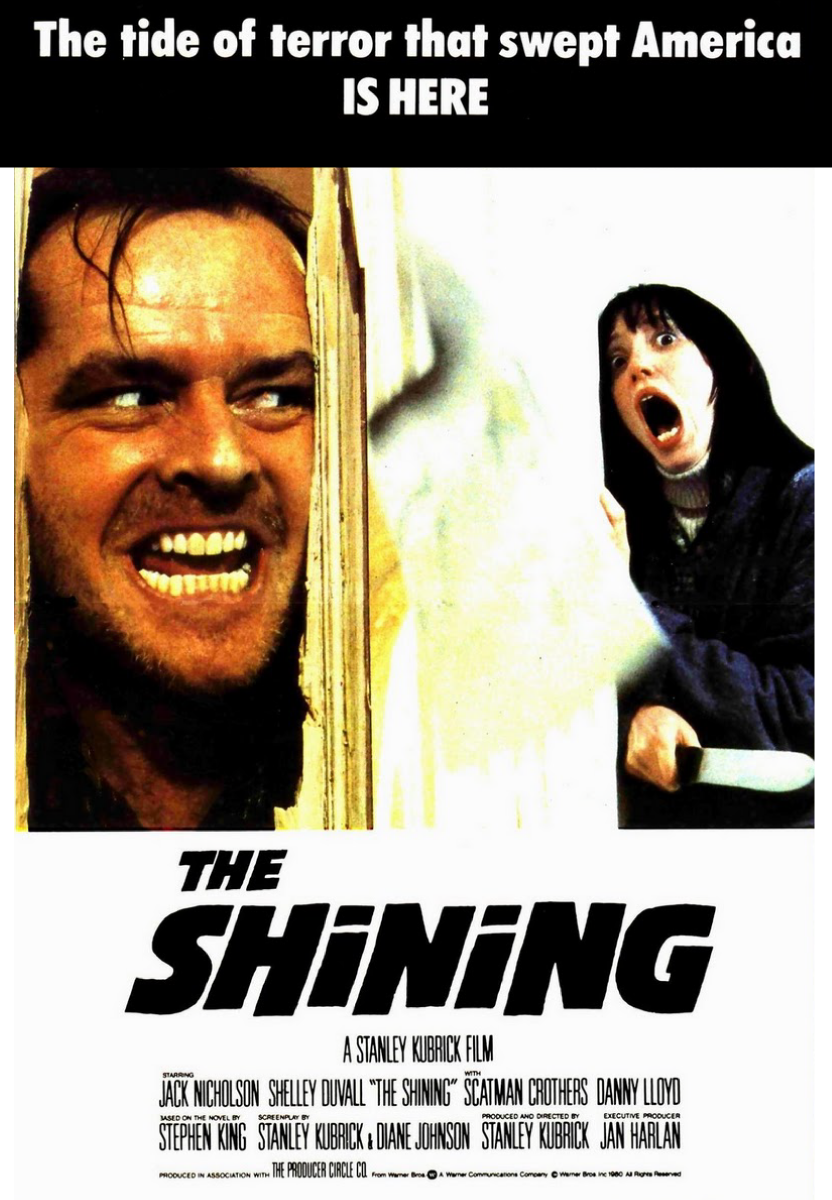
Fig 1.
“The Shining” (1980) by Stanley Kubrick recounts the preternaturally charged tale of the Torrence family and their encounter with the Overlook Hotel as a storm begins to take hold, trapping them. Featuring Kubrick’s trademark pacing and an almost microscopic attention to detail “The Shining” beckons viewers into the isolation of the Overlook, but within they will find that once inside and safe from the storm, they are instead trapped again, within the often times confusing and labyrinthine, Overlook. Of the plot, Roger Ebert muses... “Who is the reliable observer? Whose idea of events can we trust?” (Ebert, 2006)


The drab art direction within the hotel exploits a different kind of horror, the kind that you don’t encounter when running from a crazed axe-murdering interdimensional hyper lizard named Chuck. Instead, it is the kind that features in our everyday lives. Kubrick states - when discussing the conception of the art direction for the hotel -  “We wanted the hotel to look authentic rather than like a traditionally spooky movie hotel. The hotel's labyrinthine layout and huge rooms, I believed, would alone provide an eerie enough atmosphere.” (Kubrick, 1980) The Overlook Hotel is pristine, in a hospital-like manner, in which the appearance of cleanliness is upheld, but there is a sense of history - a build up of it - accumulated over a span of time, lending an eerie and in fact, unsettling quality to proceedings.


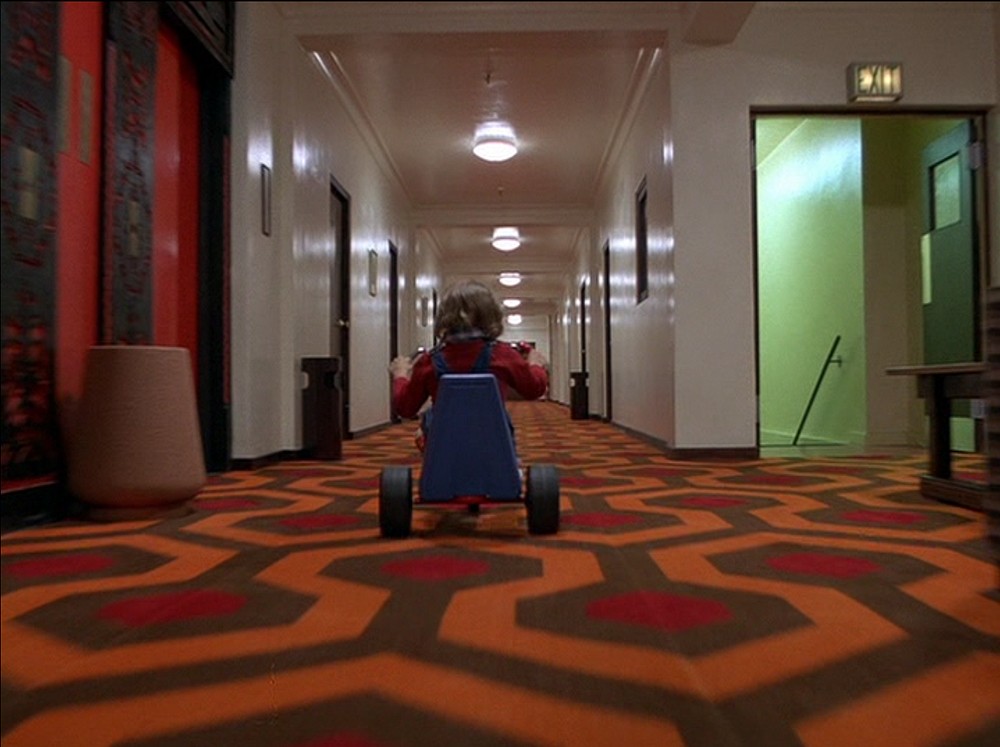
Kubrick’s camera work is exemplified in The Shining, the long steadicam shots adding a fervent dread to the claustrophobic halls. Tracking shots follow Danny through hallways, holding him at an uncomfortable distance to instill in us a sense that something is slyly pursuing him. This sense of unease is further driven home by the disparity featured in the spacial design of the Overlook. There are instances in the film where spatial continuity is marvelously broken, for instance the window in Ullman's office that features an open sky where a hotel wall should be blocking; hallways that have no logical endpoint as the hotel doesn’t continue with the, indeed the interior of room 237 encroaches upon the area where another room should exist, giving rise to ideas of a fractured reality where nothing makes sense; executive producer Jan Harlan says of the design…”It's clear instantly there's something foul going on. At the little hotel, everything is like Disney, all kitsch wood on the outside – but the interiors don't make sense. Those huge corridors and ballrooms couldn't fit inside. In fact, nothing makes sense.” (Harlan, 2012)


Fig 2.
In broad terms, it is the culmination of these things that creates the presence of the Overlook, it is seemingly imperceptible; even Wendy doesn’t seem to notice the oddities that Jack and Danny encounter, but as with Repulsion (1965) and Black Narcissus (1947) these techniques go to build the atmosphere until it is almost made flesh. The Overlook is perhaps the most evocative of the trio, becoming iconic and almost archetypal in its mundane depiction of supernatural horror in a largely normal setting.


Fig 3. 

Bibliography

Abbott, Kate. 'How We Made Stanley Kubrick's The Shining'. the Guardian. [online] Available at: http://www.theguardian.com/film/2012/oct/29/how-we-made-the-shining [Accessed 29 Nov. 2015]


Ebert, Roger. 'The Shining Movie Review & Film Summary (1980) | Roger Ebert'. Rogerebert.com. [online] Available at: http://www.rogerebert.com/reviews/great-movie-the-shining-1980 [Accessed 29 Nov. 2015]


Visual-memory.co.uk,. 'The Kubrick Site: Kubrick Speaks In Regard To 'The Shining''. [online] Available at: http://www.visual-memory.co.uk/amk/doc/interview.ts.html [Accessed 29 Nov. 2015]


Illustrations


Fig 1. The Shining Poster. [image] Available at: https://girlmeetsfreak.files.wordpress.com/2012/10/the-shining-1980-poster.png [Accessed 29 Nov. 2015].


Fig 2. Danny on trike - still. [image] Available at: http://idyllopuspress.com/idyllopus/film/images/shining/sh_tu5.jpg [Accessed 29 Nov. 2015].


Fig 3. Jack at the bar still [image] Available at: http://www.beatontheblue.com/wp-content/uploads/2013/09/JN-shining.jpg [Accessed 29 Nov. 2015]


Additional reading


Additional viewing


https://www.youtube.com/watch?v=0sUIxXCCFWw - Spatial awareness and set design in "The Shining".