
Thursday, 23 March 2017

Tuesday, 21 March 2017
Adaptation B - Mood Board

In order to be further prepared for the interim pitch, I've generated a small mood board that I hope, encapsulates the general tone I want to capture in my project.
From left to right is, Watchmen, Princess Bride, Logan, Sunset Boulevard & Birdman. All of which share a context with my project.
I'll be writing a rough script tonight before bed, with a general sense of where I'm going.
Thursday, 9 March 2017
World Cinema - "Persepolis" (2007) - A review.
 |
| Fig 1. |
"Persepolis" (2007) dir. Marjane Satrapi & Vincent Paronnaud, is a French/Iranian animated feature film based on the graphic novel of the same name, which in turn is based on Satrapi's own experiences of growing up against the backdrop of the Iranian Revolution. It was a nominee for Best Animated Feature at the Academy awards, as well as a slew of other awards, including the Palme D'or. Satrapi's other works include "Chicken with Plums" (2011) - which again, was based on another of Satrapi's graphic novels - & "The Voices" (2014) which stylistically is the furthest departure from her earlier work. Peter Bradshaw, comments that "here is an adaptation so inspired, so simple and so frictionless in its transformation of the source material that it's almost a miracle. When I tell people it's a lo-fi animation, largely in black-and-white, about Iran they put their heads in their hands and make a low groaning sound. But I've seen those same people bounce happily out of the cinema after seeing it as if they had had some sort of caffeine injection." (Bradshaw, 2008) and in truth, there's no point at which the film belies its origins on paper, though counter to that, there's never a moment where Persepolis feels flat.
 |
| Fig 2. |
"Persepolis" opens with Marjane in an airport, beginning to reminisce about her past, leading us centers on a young Marjane a regales us with her story; a coming of age tale set amidst the precarious backdrop of the Iranian Revolution, the Shah is being usurped, and the country is about to enter, what everyone believes, will be a time for democracy to prosper. The opposite is true, and Iran is plunged into uncertainty, and a constrictive regime that oppresses rather than uplifts. Marjane, "is nine years old when the waves of revolution rise to engulf the country. Waves that send her parents to the demonstrations" (Bazr, 2007) and it is within this uncertainty that drive Marjane and her growth. Although clearly being in a position of privilege amongst the other characters in this tale, she nonetheless serves as the focal point for which to witness these events. "She is from an intellectual family with a comfortable existence. But Persepolis is able to portray a universal reality (the history of a country) through the narrative of a particular and uncommon life. The history that is part of Marjane’s family heritage and shapes her life is part of the collective heritage that shapes the existence, hopes and dreams of all of us" (Bazr, 2007) in this way, much as the same as with "Waltz with Bashir" (2008) a personal story is transformed into a universal one, and in Persepolis's case, one that highlights the plight of women in particular, as the film is wise enough to highlight the difference in attitudes between Iran and Vienna, culminating in "Marjane’s conflict with various representatives of the regime in the context of continuous repression" that causes "her parents to send her abroad" (Bazr, 2007). This goes a long way into quantifying what make Persepolis an Iranian film, certainly it's focus is Iran, it's subjects Iranian, and yet, the film has been banned by religious leaders in Iran. Perhaps then, Persepolis is uniquely Iranian in so much as being able to attack it's own establishment, whilst also allowing Marjane a crucible in which to pool the events of her life into, and make sense of them.
 |
| Fig 3. |
Bibliography
Bradshaw, Pete. (2008) At: https://www.theguardian.com/film/2008/apr/25/animation.drama (Accessed on 09/03/17)
Bazr. (2007) At: http://revcom.us/a/109/awtw-persepolis-en.html (Accessed on 09/03/17)
Bazr. (2007) At: http://revcom.us/a/109/awtw-persepolis-en.html (Accessed on 09/03/17)
Davis, Lane. Wang, Bella ed. "Persepolis: The Story of a Childhood Repression and Expression in Iranian Art" (2010) At: http://www.gradesaver.com/persepolis-the-story-of-a-childhood/study-guide/repression-and-expression-in-iranian-art (Accessed on 09/03/17)
Ebert, R. (2008) At: http://www.rogerebert.com/reviews/persepolis-2008 (Accessed on 09/03/17)
Illustrations
Fig 1. Persepolis Poster. [image] At: https://i.paigeeworld.com/user-media/1422576000000/5373607ff3192bf878276785_54cadd389993972a69242a46_320.jpg (Accessed 09/03/17)
Fig 2. Marjane-(s). [image] At http://www.jsbc.fr/wp-content/uploads/2015/05/persepolis-8-1064x596.jpg (Accessed 09/03/17)
Fig 1. Persepolis Poster. [image] At: https://i.paigeeworld.com/user-media/1422576000000/5373607ff3192bf878276785_54cadd389993972a69242a46_320.jpg (Accessed 09/03/17)
Fig 2. Marjane-(s). [image] At http://www.jsbc.fr/wp-content/uploads/2015/05/persepolis-8-1064x596.jpg (Accessed 09/03/17)
Fig 3. "Punk is not Ded". [image] At: http://theredlist.com/media/database/films/cinema/2000/persepolis/010-persepolis-theredlist.jpg (Accessed 09/03/17)
Wednesday, 8 March 2017
Adaptation B - Preliminary thumbnails for Olga
At the moment I've done a few drawings purely for the purpose of ascertaining the basic shape breakdown of Olga, and throwing up any aesthetic quirks along the way. On the surface there isn't much to go from in the original outline for the character, as, honestly, she's quite generic, and wears next to nothing (thanks to the nature of the medium she's from).
Keeping my spin on the character in mind, in that, she will be used in a subversive manner that both belays her original purpose (which was to entertain and titillate) into something much more positive. Therefore, I wanted to explore different shapes that one would normally expect from a superheroine, given that we're used to large breasted, svelte and admittedly - at times - muscular forms (Wonder Woman being the obvious comparison to draw here) I wanted to explore things much closer to 'normal', even mundane. Whilst not 100% there, I am moving closer to that within these exploratory thumbnails.
TLDR - I'm thinking more 'Unbeatable Squirrel Girl' and less 'Power Girl' (though this could be subject to change).


Monday, 6 March 2017
Adaptation B - Typography influences
Apart from noticing how totally misogynistic these covers are, I thought they would also provide invaluable information in terms of project branding, in particular with typography. So I've assembled a library together and taken note of the particular fonts I like most, and how they're all combined.

I've also experimented a little with the logo for this project, and I'm leaning to want to at a little more colour here and there, so I'll be experimenting with that soon as I feel that there is more to get from these covers. I've been toying with the idea to utilise them in a much more meaningful way during the course of this project.

Sunday, 5 March 2017
Adaptation B - "Mommie Dearest" (1981) & "Sunset Boulevard" (1950) reaction.
With regards to my project, I was offered a few film suggestions that reflected the tone I wanted to evoke, that tragic, aged starlet, relevant at one point in time, and still relevant in their own heads, both of these films deal with a schism created by feeling irrelevant and the mythic tragedy this brings with it.
 |
| Norma Desmond |
So the challenge is transposing this, and adapting it into Olga. So after further reading into her character - of which very little exists, I've discovered - I found out that the character had effectively been shafted after a somewhat epic sounding story arc. In that arc, she fought in an interplanetary war, and married in order to stop it. Becoming the queen of Venus. Her past also bore interesting tidbits, something that I will focus on in a later post, but sufficed to say, she experienced a lot of abuse during her childhood, which I feel like will affect her outlook as an older person.
So, in a discussion with Phil, he noted that the interesting part there was that she was shelved. Obsolete in some way, and that's what I should be focusing on. He recommended that I watch Sunset Boulevard, so I did.
After viewing "Sunset Boulevard" I happened on the idea that my character - Olga Mesmer - the first female superhero in comics, would follow a similar path to Norma Desmond in terms of the 'aftermath' of her career. Would Olga experience the same maddening irrelevance as Norma? Indeed, it seemed as though she would. Living in a decrepit old mansion surrounded by heirlooms of her past, herself effectively living in the past, Norma lives in the waning light of her stardom. The ultimate gut punch being when we learn that her butler - a creepy almost omnipresent manservant - is actually one of her ex husbands. Himself, trapped in the faded stars enacting of the past. The whole film basks in this potent twilight, and you find yourself silently hoping that things could just go in Norma's favour. The ending almost paradoxically grants Norma her fame back, whilst also damning her to a life in prison for murdering Joe Gillis; the dual nature of this ending furthering the complexity of Norma's condition, for all at once she displays an awareness of her own irrelevance, whilst also displaying an uncanny ability to lie to herself about the nature of her reality.
From this I took that I should focus on the twilight years, with an older Olga. Though I encountered a problem. After further research into Olga Mesmer, I had discovered that she had been granted 'unaging immortality' at the end of her original story. But again, after further talking with both Phil & Alan, it became clear to me that age can be more than just a physical attribute, age affects the mind. So again, I asked myself what would Olga be like in that circumstance?
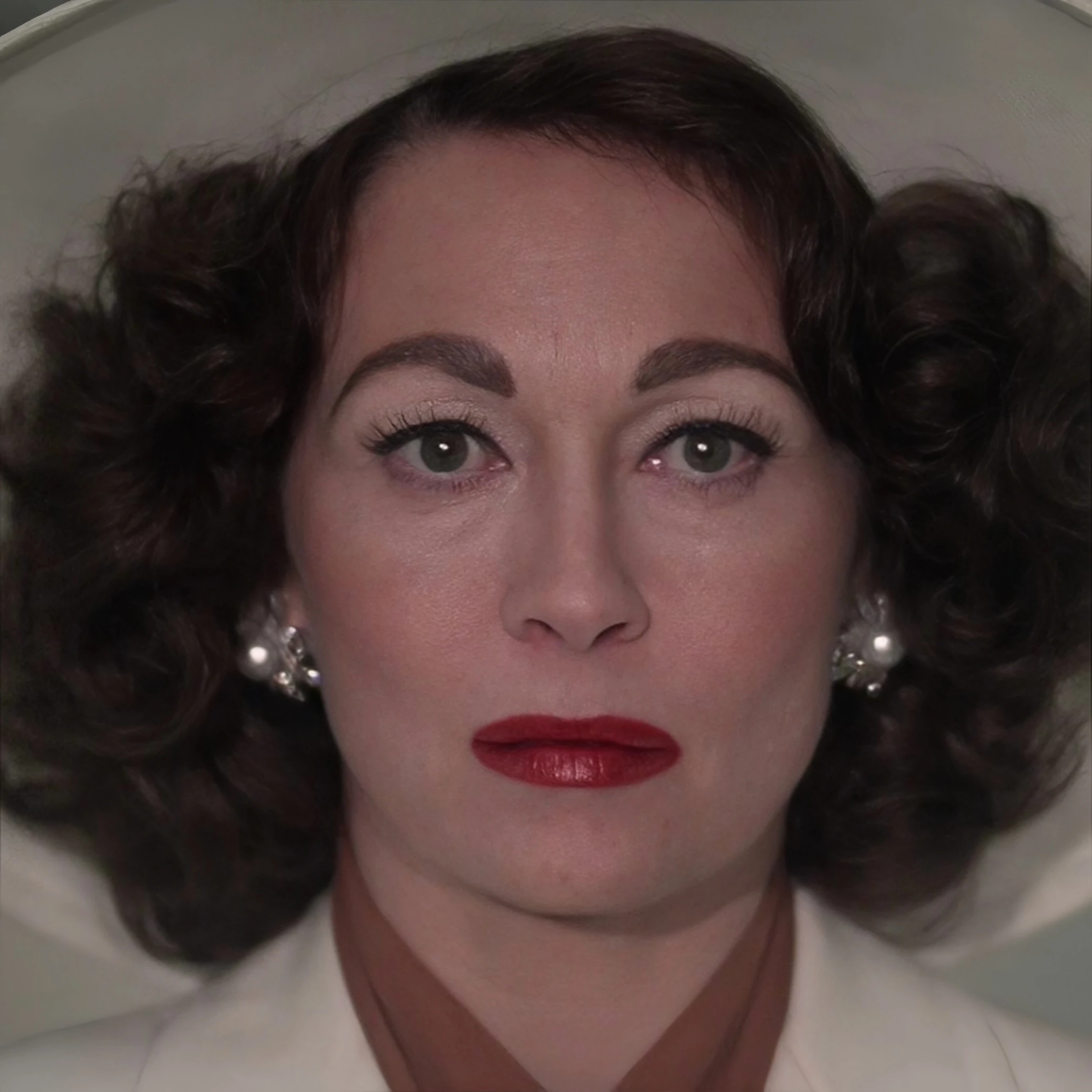 |
| Faye Dunaway as Joan Crawford |
So, attitudinally, I have something to work on. There are a few things that Alan suggested in our last meeting regarding to format, and an extremely interesting suggestion that I look at the opening of Watchmen for inspiration. Especially as I had mentioned to him that I saw Olga as someone that could be a feminist icon in some kind of alt-world situation. I will follow that trail of thought up in another post though...
Friday, 3 March 2017
Pipeline 01 - Skinning 05 - Blendshape interpolators and completion

Just finished up the last of the Skinning tutorials, ready to move on to the Rigging ones. It's really nice seeing this model as it's created, knowing that it started off as nothing and is now attaining some form of complexity.
Below are a couple of videos that contain a few playblasts that demonstrate the skinning at play here.
Subscribe to:
Posts (Atom)